
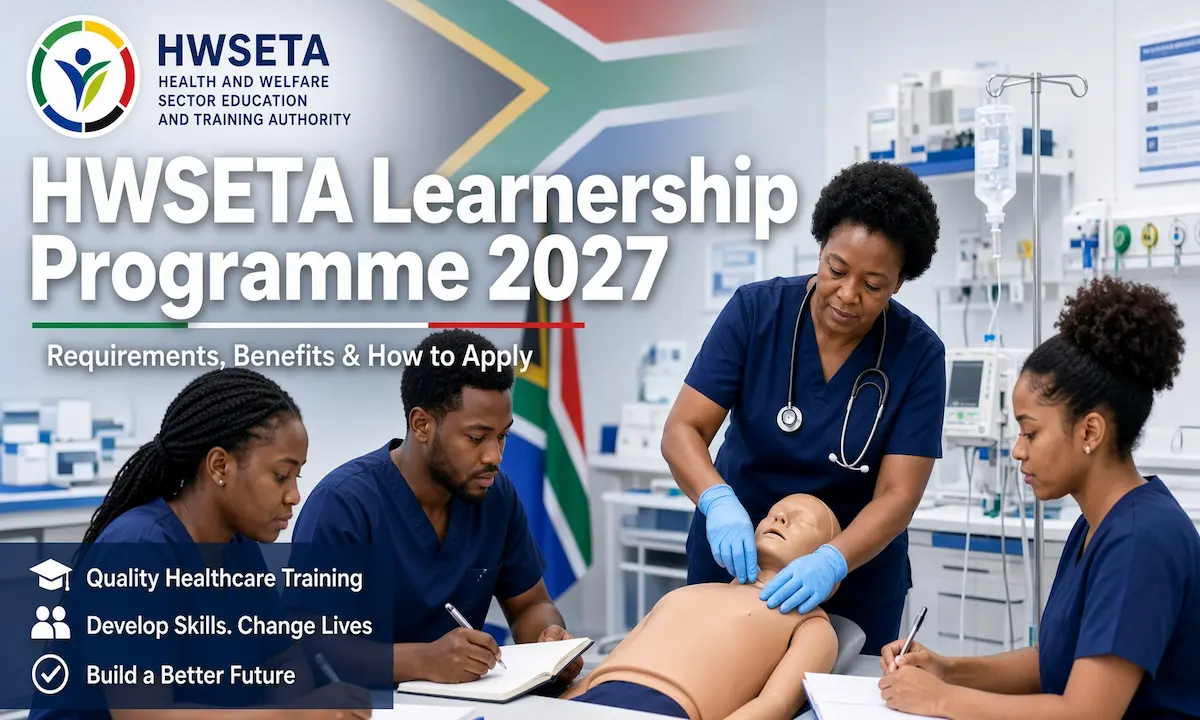
The HWSETA Learnership Programme 2027 offers young South Africans a practical pathway into the health, social development and veterinary sectors. The Health and Welfare Sector Education and Training Authority (HWSETA) funds structured learnerships that combine theoretical training with real workplace experience. Successful learners earn a nationally recognised qualification registered on the National Qualifications Framework (NQF) and receive a monthly stipend while they train.
These programmes address critical skills shortages in hospitals, clinics, NGOs, pharmacies and community services while improving employability for unemployed youth. There is no single central application form for all HWSETA learnerships 2027. Opportunities are advertised and managed by employers, training providers, hospitals and TVET colleges that receive HWSETA discretionary grant funding.
What Is the HWSETA Learnership Programme?
A learnership is a structured work-based learning programme. It consists of theoretical classes (often delivered by an accredited training provider) and supervised practical experience in a real workplace. On completion, learners receive a SAQA-registered qualification and are better positioned for permanent employment or further studies.
HWSETA focuses on three main sectors:
- Health (nursing, pharmacy, phlebotomy, community health)
- Social development (social auxiliary work, child and youth care)
- Veterinary and animal care
Programmes typically run for 12 to 24 months depending on the qualification and NQF level.
Popular HWSETA Learnership Programmes for 2027
Availability depends on employer funding and provider capacity, but the following are among the most frequently offered:
Health Sector
- Higher Certificate in Auxiliary Nursing (NQF Level 5)
- Pharmacy Assistant (Basic and Post-Basic) – National Certificate NQF 3 and FETC NQF 4
- FET Certificate in Phlebotomy Techniques (NQF Level 4)
- Occupational Certificate: Health Promotion Officer
- Community Health Worker programmes
Social Development
- Occupational Certificate: Social Auxiliary Worker (NQF Level 5)
- Occupational Certificate: Child and Youth Care Worker
- FET Certificate in Social Auxiliary Work and Child and Youth Care
Veterinary
- University Diploma in Veterinary Nursing
One concrete 2027 example is the Ampath Laboratories Phlebotomy Technician Learnership. It is a 24-month full-time programme (starting late January 2027) fully funded by HWSETA and Ampath, with training locations in Centurion and Durban. Applications for that specific intake closed in April 2026, illustrating how individual programmes open and close at different times.
HWSETA Learnership Requirements 2027
Requirements vary by programme, but most share these core criteria:
- South African citizen
- Aged 18 to 35 years
- Currently unemployed and not registered for another learnership or full-time study
- Matric (Grade 12) certificate (some programmes accept Grade 10 or 11; others require specific subjects such as Mathematics, Life Sciences or English with minimum marks)
- No criminal record
- Good communication and interpersonal skills
- For some health programmes: specific subject requirements (e.g., 60% in Pure Mathematics, Life Sciences and English for certain phlebotomy learnerships)
- Must not hold a qualification higher than NQF Level 4 for certain youth-focused funding streams
Always check the specific advert, as employers may add additional criteria such as provincial preference, medical fitness or assessment tests.
Benefits of the HWSETA Learnership Programme 2027
- Nationally recognised qualification: Registered on the NQF and often linked to professional bodies (SANC, SAPC, HPCSA, SACSSP, etc.)
- Monthly stipend: Learners receive an allowance that meets or exceeds the legal minimum set under the National Minimum Wage Act. Typical amounts range from approximately R3 000 to R6 500 per month depending on NQF level and credits earned. The legal floor starts around R2 000 per month for early-stage learners and increases as credits are completed.
- Practical workplace experience: Real exposure in hospitals, clinics, pharmacies or community organisations
- Improved employability: Many learners are absorbed into permanent roles or progress to higher qualifications
- No tuition fees: Fully or largely funded by HWSETA discretionary grants
- Pathway to professional registration: For example, phlebotomy technicians can register with the HPCSA after successful completion
How to Apply for HWSETA Learnerships 2027
Important: You do not apply directly to HWSETA for most learnerships. Follow these steps:
- Prepare your documents early
- Certified copy of South African ID
- Certified Matric certificate and statement of results
- Updated CV
- Proof of residence
- Any additional certificates or affidavits requested
- Search for opportunities
Monitor:- Official websites and careers pages of major employers (Netcare, Mediclinic, Life Healthcare, Ampath, provincial Departments of Health, large NGOs)
- HWSETA website (www.hwseta.org.za) for funding announcements and provider lists
- Reputable job and learnership portals
- Local TVET colleges and community organisations
- Submit applications early
Individual programmes open at different times, often between late 2026 and mid-2027 for intakes starting in 2027. Closing dates are strict. Submit complete applications only through official channels. Never pay anyone to “secure” a learnership. - Attend assessments and interviews
Shortlisted candidates are usually invited for interviews, assessments or medical checks.
Career Opportunities After Completion
Successful completion opens doors to roles such as:
- Auxiliary nurse or enrolled nursing assistant
- Pharmacy assistant in retail or hospital pharmacies
- Phlebotomy technician in laboratories
- Community health worker or health promotion officer
- Social auxiliary worker
- Child and youth care worker
- Veterinary nurse support roles
Many learners continue studying toward higher qualifications (e.g., from Basic to Post-Basic Pharmacist Assistant, or Auxiliary Nursing toward further nursing qualifications).
Important Tips and Warnings
- Always verify information on the official HWSETA website (www.hwseta.org.za) or the employer’s official portal. Contact HWSETA on 011 607 6900 or hwseta@hwseta.org.za if needed.
- Beware of scams that ask for payment or personal banking details upfront.
- Keep copies of all applications and follow up professionally.
- Requirements and funding windows change annually. What was available in previous years may differ for the 2027 intake.
The HWSETA Learnership Programme 2027 remains one of the strongest structured opportunities for young South Africans who want to build a career in health and welfare while earning while they learn. Start preparing your documents now and monitor employer websites regularly for openings.
For the latest official updates, visit www.hwseta.org.za.