
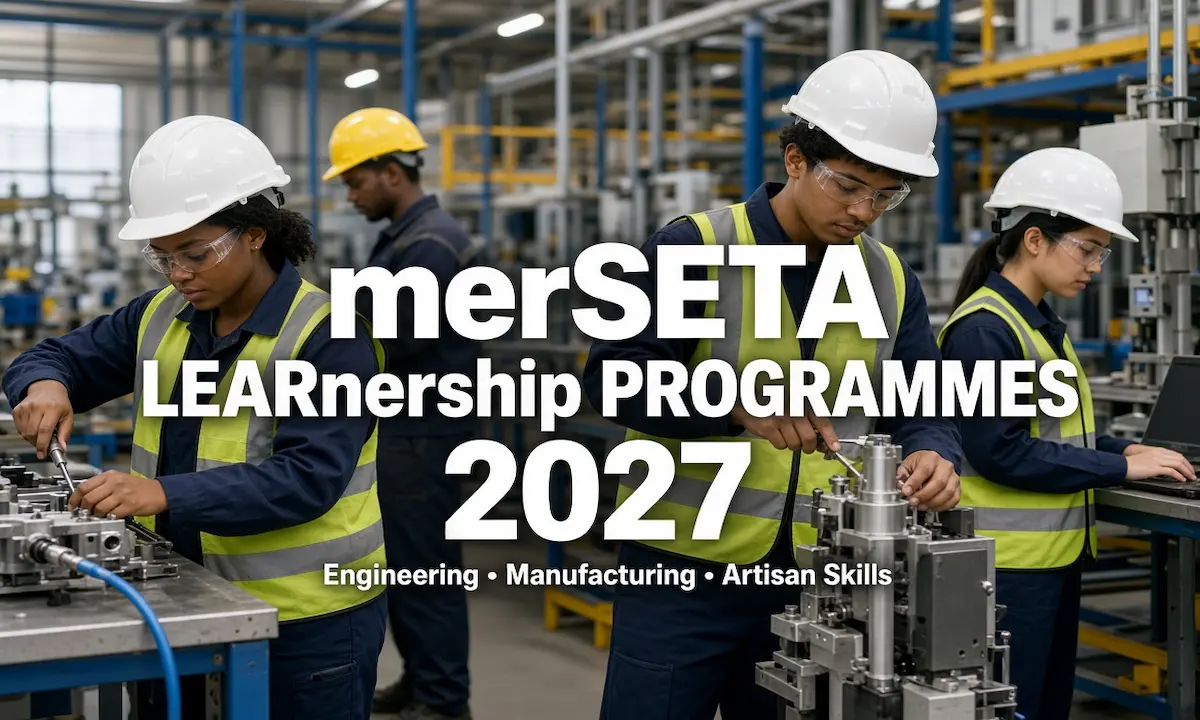
The Manufacturing, Engineering and Related Services Sector Education and Training Authority (merSETA) is one of South Africa’s most important SETAs for technical skills development. It supports the manufacturing, engineering, automotive, metal, plastics, tyre and motor retail sectors. For young people looking to build careers as artisans, technicians or skilled manufacturing workers, merSETA learnerships and apprenticeships remain a strong pathway into industry in 2027.
This guide explains how merSETA programmes work, the main fields available, typical entry requirements, stipend information, how applications actually happen, and practical steps to improve your chances of selection.
What Is merSETA and How Do Its Learnerships Work?
merSETA funds and quality-assures skills development across six main chambers: Metal and Engineering, Auto Manufacturing, Motor Retail, Components Manufacturing, New Tyre Manufacturing, and Plastics. These industries form a large part of South Africa’s industrial economy and continue to need skilled workers, especially artisans and technicians.
A merSETA learnership is a structured programme that combines classroom or theoretical training with practical workplace experience. It leads to a qualification registered on the National Qualifications Framework (NQF). Most learnerships run for 12 to 24 months. For full artisan status (the Red Seal), candidates usually complete a longer apprenticeship pathway that includes multiple levels and ends with a trade test.
Important point: merSETA itself does not recruit individual learners in most cases. It allocates Discretionary Grant funding to employers, training providers, TVET colleges and other approved organisations. These hosts then advertise opportunities and select candidates through their own recruitment processes.
Why merSETA Programmes Matter for 2027
South Africa continues to face shortages of artisans and skilled technical workers. merSETA’s funding supports apprenticeships, learnerships, skills programmes, artisan recognition of prior learning (ARPL), internships and related interventions. The 2026/27 Discretionary Grant windows were structured to support levy-paying and non-levy-paying employers, SMMEs, government entities, TVET colleges, higher education institutions and skills development providers.
These programmes help address industry demand in areas such as fitting, turning, welding, boilermaking, millwright work, toolmaking, motor mechanics, mechatronics and related trades. Completing a merSETA programme gives you both a recognised qualification and real workplace experience — two things employers value highly.
Popular merSETA Fields and Trades for 2027
Opportunities commonly appear in the following areas:
- Metal and engineering trades (fitter, turner, fitter and turner, welder, boilermaker, millwright, toolmaker, rigger, instrumentation)
- Automotive and motor trades (motor mechanic, diesel mechanic, body repair, spray painting)
- Manufacturing and production roles
- Plastics and related processing
- Mechatronics and emerging technical skills linked to Industry 4.0
- Supervisory and quality-related pathways in manufacturing environments
Entry-level learnerships may start at NQF Level 2 or 3, while higher technical and artisan routes build towards NQF Level 4 and the Red Seal.
Typical Requirements for Applicants
Requirements differ by programme and host employer, but most share these core criteria:
- South African citizenship
- Age usually between 18 and 35 for unemployed-learner programmes (some apprenticeship routes accept younger candidates under specific conditions)
- Unemployed status for the majority of 18.2 (unemployed) learnerships
- Minimum education of Grade 10, Grade 12 or relevant N1–N3 certificates, depending on the trade
- Mathematics and Physical Science (or Engineering Science) are often required or preferred for technical and engineering trades
- Willingness to work shifts, attend workplace training and meet physical demands of the trade where applicable
- No previous completion of the same or a conflicting learnership in many cases
Always read the specific advertisement carefully. Some programmes prioritise equity targets, people with disabilities or candidates from particular provinces or communities.
Stipends and Financial Support
Unemployed learners on merSETA-funded learnerships receive a monthly allowance. The exact amount depends on the NQF level, the number of credits completed, the employer and the specific programme conditions. Legal minimum learner allowances are set under the National Minimum Wage Act and increase with higher NQF levels and credits. In practice, many employers in the manufacturing and engineering sector pay above the minimum, with reported ranges often falling between roughly R3 000 and R7 500 per month depending on the programme and stage.
The stipend is an allowance to support transport, meals and basic living costs. It is not a salary. Legitimate programmes are free to apply for. Never pay application, registration or placement fees.
How to Find and Apply for merSETA Learnerships in 2027
There is no single permanent national application form. Opportunities open throughout the year as employers and providers receive funding and begin recruitment. Follow these practical steps:
- Decide which technical field or trade interests you and matches your current qualifications.
- Regularly check the official merSETA website (merseta.org.za) for notices, Discretionary Grant updates and approved learnerships.
- Monitor careers pages of major manufacturers, automotive companies, engineering firms, metal companies and related employers.
- Register on platforms such as SA Youth and watch accredited training providers and TVET college notices.
- Prepare certified copies of your ID, Matric or highest qualification, N certificates if relevant, updated CV and proof of residence.
- Apply only through the official channel stated in each advert.
- Submit before the closing date and keep proof of your application.
Discretionary Grant windows open periodically. Successful applicants sign a formal learnership or apprenticeship agreement before training starts.
APPLY ON THE OFFICIAL WEBSITE https://www.merseta.org.za/skills-development/curriculum-learning-programmes/learnerships/
Safety Advice – Avoid Scams
Scams targeting technical and engineering learnerships are common. Protect yourself by:
- Applying only through official company websites, merSETA notices or recognised providers
- Never paying money to “secure” a place or for “registration”
- Verifying the training provider’s accreditation where possible
- Being cautious of social media posts promising guaranteed placement
Benefits of Completing a merSETA Programme
Successful learners leave with a nationally recognised qualification, practical workplace experience, improved technical skills and stronger employability. Artisan pathways that lead to the Red Seal open doors to further opportunities in manufacturing, maintenance, fabrication and related industries. Many participants later secure permanent roles, pursue further studies or start their own technical businesses.
Final Tips for 2027 Applicants
Prepare your documents early and keep them updated. Monitor official sources regularly rather than relying only on third-party listings. Apply to multiple relevant programmes to improve your chances. Treat every application seriously — complete documents and a clear motivation letter make a difference.
merSETA learnership and apprenticeship programmes for 2027 offer a structured, paid route into South Africa’s manufacturing and engineering industries. By focusing on legitimate opportunities, matching your profile to the right trade and applying carefully, you can position yourself for skills, experience and better long-term career prospects in technical fields.
Check the merSETA website, major employer career pages and accredited training providers regularly for the latest 2027 openings.