
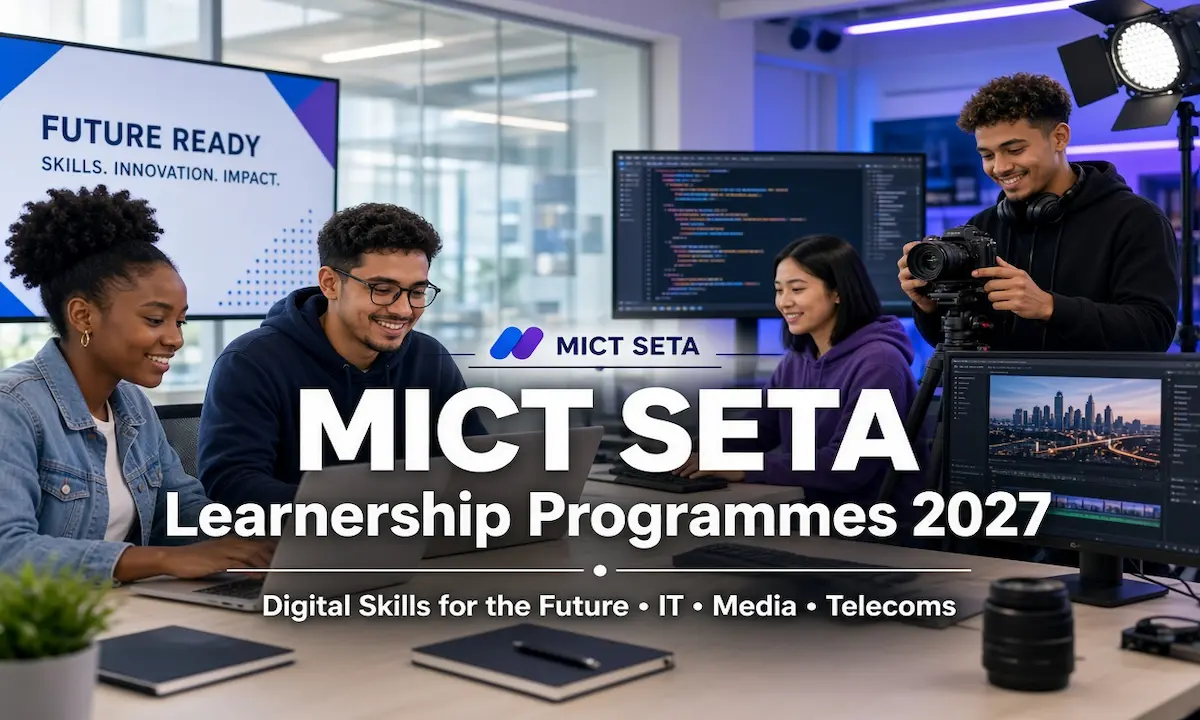
The Media, Information and Communication Technologies Sector Education and Training Authority (MICT SETA) supports skills development in one of South Africa’s fastest-growing sectors. As the digital economy expands, MICT SETA learnerships remain a practical pathway for unemployed youth to gain workplace experience, a nationally recognised qualification and a monthly stipend while building careers in technology, media, telecommunications and related fields.
This guide explains what MICT SETA learnerships involve, the main fields available for 2027, typical requirements, stipend details, how to apply safely and where to find legitimate opportunities.
What Is MICT SETA and How Do Its Learnerships Work?
MICT SETA covers five interconnected sub-sectors: information technology, telecommunications, electronics, advertising, and film and electronic media. These industries increasingly overlap as companies combine software, data systems, digital platforms, telecommunications infrastructure and audiovisual content.
A MICT SETA learnership is a structured work-based programme that combines theoretical training with practical workplace experience. It leads to a qualification registered on the National Qualifications Framework (NQF). Most programmes last 12 months, while some extend to 18 months depending on the qualification level.
MICT SETA does not recruit learners directly in most cases. It allocates Discretionary Grant funding to employers, accredited training providers, TVET colleges and other approved organisations. These hosts then advertise and select candidates for specific programmes.
Why MICT SETA Learnerships Matter for 2027
South Africa faces ongoing shortages in digital and ICT skills. MICT SETA’s funding plans for the 2026/27 period target thousands of unemployed learners across learnerships, internships, skills programmes and work-integrated learning placements in all nine provinces. These interventions support the National Skills Development Plan and help prepare young people for roles in software development, technical support, cybersecurity, digital media, telecommunications and related areas.
Completing a MICT SETA learnership improves employability by giving you both a formal qualification and real workplace references. Many learners later move into permanent roles with their host employers or related companies.
Popular MICT SETA Learnership Fields for 2027
Programmes typically focus on high-demand digital and media skills. Common areas include:
- Systems development and software development
- Technical support and end-user computing
- Information and cybersecurity
- Network support and telecommunications
- Digital marketing and advertising
- Film, media production and electronic media
- Electronics and related technical skills
- Data-related and emerging technology pathways
Newer occupational qualifications are increasingly part of the landscape, while older historically registered qualifications have transitional arrangements. Always check the specific qualification listed in each advert.
Typical Requirements for MICT SETA Learnerships 2027
Requirements vary by programme and host, but most share these core criteria:
- South African citizenship
- Age usually between 18 and 35
- Unemployed status for the majority of unemployed-learner (18.2) programmes
- Minimum of Grade 12 (Matric) or an equivalent NQF level; some programmes accept lower levels or specific technical certificates
- No previous completion of the same or a similar learnership
- Willingness to attend training and workplace sessions as required
- Clear criminal record in certain cases
Some specialised or higher-level programmes may require Mathematics, specific subjects or prior technical qualifications. Programmes focused on people with disabilities sometimes have adjusted age or other criteria. Always read the individual advert carefully.
Stipends and Financial Support
Unemployed learners on MICT SETA-funded learnerships typically receive a monthly stipend. Official guidance has indicated a baseline of R2 500 per month for many funded programmes, subject to attendance and programme conditions. In practice, some host employers offer higher amounts, with reported ranges often falling between R2 500 and R6 500 depending on the NQF level, the employer and the specific opportunity.
The stipend is an allowance to support transport, meals and basic living costs. It is not a salary. Legitimate programmes are free to apply for. Never pay application, registration or placement fees.
How to Find and Apply for MICT SETA Learnerships in 2027
There is no single national application form or permanent open intake. Opportunities open throughout the year as employers and providers receive funding and begin recruitment. Follow these practical steps:
- Identify the digital or media field that matches your interests and current qualifications.
- Regularly check the official MICT SETA website (mict.org.za) for notices, funding updates and stakeholder information.
- Visit the careers pages of major sector employers such as telecommunications companies, IT firms, media organisations and digital agencies.
- Register on platforms such as SA Youth and monitor accredited training providers.
- Prepare certified copies of your ID, Matric certificate or highest qualification, updated CV and proof of residence.
- Apply only through the official channel stated in each advert (online form, email or specified submission method).
- Submit before the closing date and keep proof of your application.
Discretionary Grant windows open periodically. Successful applicants sign a learnership agreement before the programme starts.
APPLY ON THE OFFICIAL WEBSITE https://mict.org.za/learnerships/
Important Safety Advice
Scams targeting digital and IT learnerships are common. Protect yourself by:
- Applying only through official company websites, MICT SETA notices or recognised providers
- Never paying money to “secure” a place
- Verifying the training provider’s accreditation where possible
- Being cautious of social media posts promising guaranteed placement or asking for fees
Benefits of Completing a MICT SETA Programme
Successful learners leave with a nationally recognised qualification, practical workplace experience, improved digital skills and stronger employability. The combination of theory, hands-on work and mentorship builds both technical competence and professional habits. Many participants later secure permanent roles, pursue further studies or start digital freelancing or small businesses.
Final Tips for 2027 Applicants
Prepare your documents early and keep them updated. Monitor official sources regularly rather than relying only on third-party listings. Apply to multiple relevant programmes to improve your chances. Treat every application seriously — complete documents and a clear motivation letter make a difference.
MICT SETA learnership programmes for 2027 offer a structured, paid route into South Africa’s digital and media industries. By focusing on legitimate opportunities, matching your profile to the right field and applying carefully, you can position yourself for skills, experience and better long-term career prospects in technology and communications.
Check the MICT SETA website, major employer career pages and accredited training providers regularly for the latest 2027 openings.